1 tip for the Belgian driving licence

You know the rules, but tricky wording makes you get questions wrong.
What you need to know
50 questions, 41/50 required. Two serious faults (alcohol, speed, priority) = automatic failure, regardless of your overall score.What you will gain
By applying the double reading method and targeting trick questions, you drastically reduce your avoidable mistakes and pass on your first attempt.Warning
A validated answer is final: you cannot go back. Take the time to read carefully before clicking.
Many candidates fail not because of a lack of knowledge, but because they read too fast. Words like "always", "never" or "except" change the entire meaning of a question. In this article, I show you how to spot them and avoid serious faults that cost 5 points at once.
The tip nobody tells you before the Belgian theory test
You study the signs, the right-of-way rules, the braking distances. You know the rules. And yet, you might still fail a question you know perfectly well. Not because of the content. Because of the form. The wording of the questions is designed to trip you up.
According to monpermisdeconduire.be (official GOCA network), the Belgian theory test contains 50 questions, read aloud. You have 15 seconds to answer each one. Many are built around a negation or a double conditional. The result: you know the rule, yet you still get the question wrong.
The key tip: read every question twice before answering. Once to understand it, once to spot the trap words, “never”, “always”, “unless”.
This is not a minor detail. According to GOCA data and official documents from the Walloon Parliament, the pass rate for the theory test is 37% in Wallonia in 2025 (152,005 tests), meaning nearly 2 out of 3 candidates fail. The 54% figure actually refers to the practical test (87,162 tests). The two rates were swapped in the agency dispatch picked up by the press in January 2026. In Brussels, it is even worse: only 41% pass, meaning close to 60% fail. The wording of the questions is one of the main causes.
Why the questions are worded to mislead you
The logic of the Belgian test
The test does not only assess your memory. It evaluates your ability to apply a rule in a concrete situation. Negative formulations, “it is forbidden not to…”create an immediate cognitive overload.
Your brain reads fast. It matches the keyword to the memorised rule. It skips the negation.
Guaranteed automatic failure
Alcohol, speed, priority: each serious fault costs 5 points.
The scoring system makes the problem worse. According to monpermisdeconduire.be, there is a clear distinction between minor faults and serious faults:
- Minor fault: −1 point
- Serious fault (3rd or 4th degree offence): −5 points
- Two serious faults = automatic failure, regardless of your score on the other questions
In other words: you can get 48 correct answers and still fail. Two mistakes on alcohol, speed or right-of-way, and the test is over. No resit. No compensation.
The words you absolutely must watch out for
- “always”: almost always false in the highway code
- “never”: same, exceptions exist
- “except”: changes the entire meaning of the sentence
- “only”: a strong restriction, often a trap
Train yourself to mentally spot these words before processing the question. Not after. Before.
How to apply this tip in practice
The 3-second method
- Read the entire question without looking at the answers
- Identify the trap word if there is one
- Rephrase the question in your head in plain language
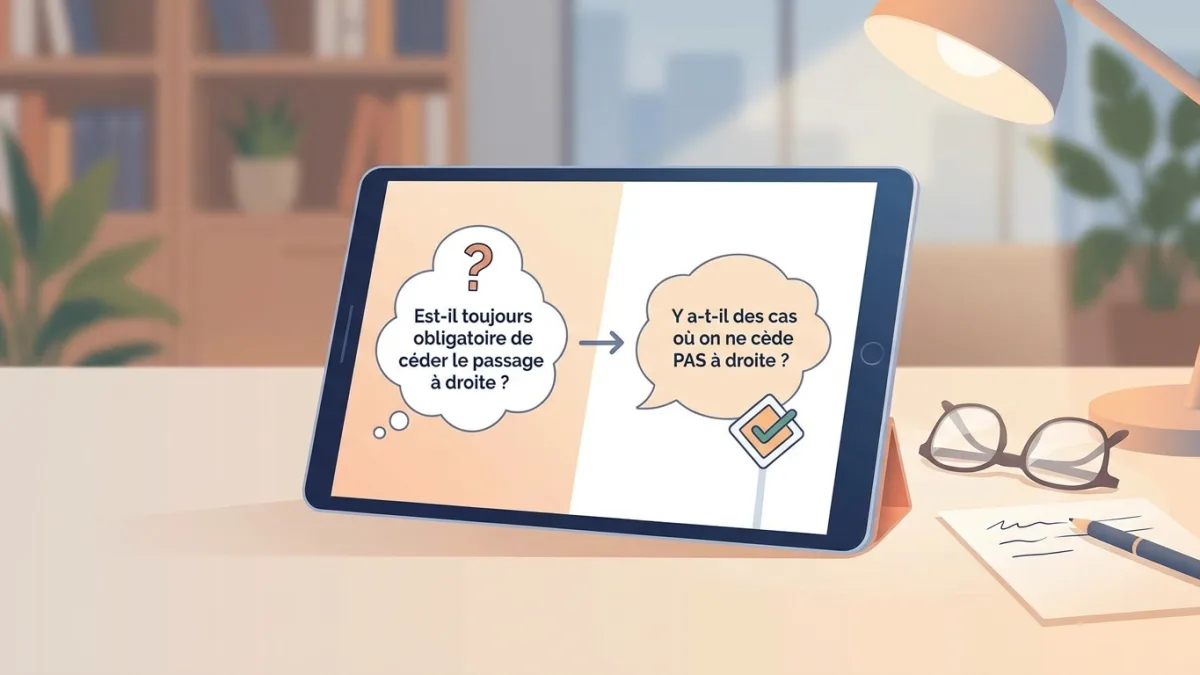
Concrete example: “Is it always compulsory to give way to the right?” → You rephrase: “Are there cases where you do NOT give way to the right?” → Yes: priority roads. Answer: false.
According to PermisPass.be, the trickiest topics to watch out for are:
- Right-of-way rules (priority to the right, roundabouts, give-way signs)
- Alcohol, drugs and medication
- Speeding and dangerous overtaking
- Failure to comply with the instructions of a qualified officer
Read the question
Read it fully without looking at the answers.
Spot the trap
Identify key words: never, always, except.
Rephrase
Rewrite the question in plain language in your head.
Practising specifically on trick questions
Do not revise all questions in the same way. Identify the ones you hesitated on or got wrong. These are almost always questions with negative or conditional wording, they deserve separate, targeted, repeated practice.
Spend 30% of your revision time on the questions you get wrong, not on the ones you already know.
💡 Expert tip: Aim for a consistent score above 45/50 in mock tests before sitting the real exam. The official pass mark is 41/50, but this safety margin protects you against unexpected serious faults on the day.
Real-world experience
The founder of Permis Online accompanied 14 candidates to the door of the test centre to help them manage their stress on the day. The consistent finding: those who had made double-reading a habit made significantly fewer errors on negatively worded questions, regardless of their overall knowledge of the highway code.
The time trap: don’t go too fast
The pressure of the clock
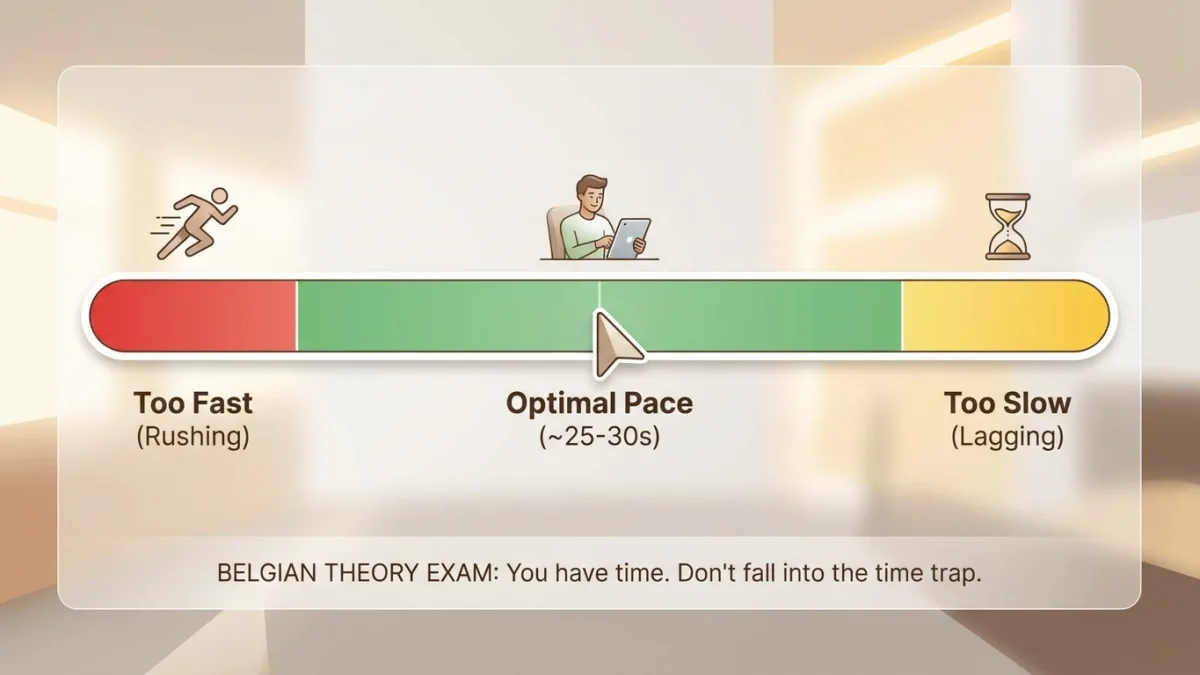
The Belgian theory test lasts approximately 30 minutes for 50 questions. That is 25 to 30 seconds per question, including the oral reading, according to data from monpermisdeconduire.be. You have time. Really.
Yet the majority of candidates finish well before the end. They rush. They skim-read. They confirm their answer without re-reading.
| Behaviour | Average time | Estimated error rate |
|---|---|---|
| Quick reading (1 pass) | 20 à 25 min | High |
| Systematic double reading | 35 à 45 min | Low |
| Reviewing answers at the end | 50 à 55 min | Very low |
The two-reading rule
Double reading = 15 extra seconds per question. Over 50 questions, that is 12 more minutes. You still finish well within the time limit. And you avoid silly mistakes.
Note: once you have confirmed your answer, you cannot go back. Each question is final. All the more reason to take the time to read carefully before clicking.
What this changes for your preparation
Permis Online offers question sets organised by topic and difficulty level. This filtering lets you target precisely the questions with complex wording, the ones where the form is just as misleading as the content.
The goal is not to do 1,000 questions. It is to understand why you get certain questions wrong.
One understood mistake is worth ten extra questions.
Spot the trap word. Rephrase. Memorise the logic, not the answer.
According to 2025 statistics published by La Libre Belgique, the theory test pass rate varies significantly by region: 54% in Wallonia, but only 41% in Brussels (2025 data, confirmed). A gap of 13 percentage points. Targeted preparation makes all the difference.
Frequently asked questions
The key to moving fast is choosing the right pathway and not skipping any steps. In Belgium, the driving school pathway is the fastest: with a minimum of 20 hours of practical lessons, you can get your licence within a few months. The independent pathway is cheaper, but the minimum training period varies by region: 3 months in Wallonia, 5 months in Flanders and 9 months in Brussels. In all cases, passing the theory test first time avoids unnecessary delays: every failure costs you time and money.
To move fast, complete each step in the right order without losing time between them. The official process has four stages: theory test, Hazard Perception Test (HPT), practical training, then practical test. According to the FPS Mobility and Public Works, the theory test is available from age 17 and the practical test from age 18. Since 1 January 2026, you must complete your entire training in the same region (Wallonia, Brussels or Flanders). Plan your journey from the start to avoid any unpleasant surprises.
- Sit the theory test from age 17 so you don’t lose time
- Book your practical test only when you genuinely feel ready
- Don’t overlook the HPT: without it, you cannot access the practical test
- Choose the driving school pathway if speed is your priority
The theory test has 50 questions and requires a minimum of 41/50 to pass. The trap to avoid at all costs: serious faults (alcohol, mobile phone, speeding, right-of-way…) cost 5 points eachtwo such errors are enough to trigger automatic failure, according to the official rules published by monpermisdeconduire.be. A common mistake: sitting the test with an average mock score of 41 or 42, thinking that is enough. That is not a margin, it is the bare minimum. Aim for 45/50 in practice to absorb the unexpected.
In 2025, the practical test pass rate was 37% in Wallonia and 51% in Brussels, according to La Libre Belgique (January 2026, confirmed figures). Serious preparation makes all the difference. Examiners assess your technical control, but also your decision-making and hazard anticipation. Certain faults lead to immediate failure: running a red light, failing to come to a complete stop at a STOP sign, or not respecting a right-of-way. Practise on the routes around the test centre you have chosen and arrive early.
After two failures in the theory test, you are required to complete 12 hours of lessons at an approved driving school before you can sit it again. Between two attempts, you must wait at least one working day. Use that interval to target your weak points using detailed corrections and mock tests, rather than resitting without any additional preparation. Be aware: many candidates repeat the same questions without analysing why they failed, this is the most common mistake at this stage.
The Hazard Perception Test (HPT) is a compulsory step to access the practical test in all three Belgian regions. It takes place on a computer: you watch videos of real driving situations and must identify hazards as quickly as possible. Its format varies by region: in Wallonia it is a separate test taken before the practical test, in Flanders it is taken on the same day as the practical test, and in Brussels it is integrated into the practical test as the first element. In 2025, more than 70% of Walloon candidates passed the HPT, according to SPW Mobility data cited by BX1. Do not underestimate it: practise with video simulations before sitting it.
Three pathways exist in Belgium: the independent pathway (M36), the driving school pathway (M18) and direct access. The independent pathway is the least expensive, with basic exam and administrative fees of between €200 and €350 according to the Moniteur Automobile (2026), and a total cost of between €650 and €900 according to PermisPass.bebut the minimum training period varies by region (3 months in Wallonia, 5 months in Flanders, 9 months in Brussels) and 1,500 km must be logged in a roadbook in Wallonia and Flanders. The driving school pathway costs more (between €1,200 and €1,500 for 20 hours of training on the standard pathway, and between €1,800 and €2,500 for direct access, according to Permis Online (2026), the upper end being reserved for direct access rather than the standard pathway, and up to €3,000 with theory lessons and enhanced support) but offers professional guidance and faster access to the test. Many candidates combine both pathways to optimise cost and efficiency.